Department of Strategic Foresight & Scenario Planning · Articles · Defence Technology ·
Drone Warfare in West Asia: How Cheap Drones Are Transforming Precision Strikes and Military Power
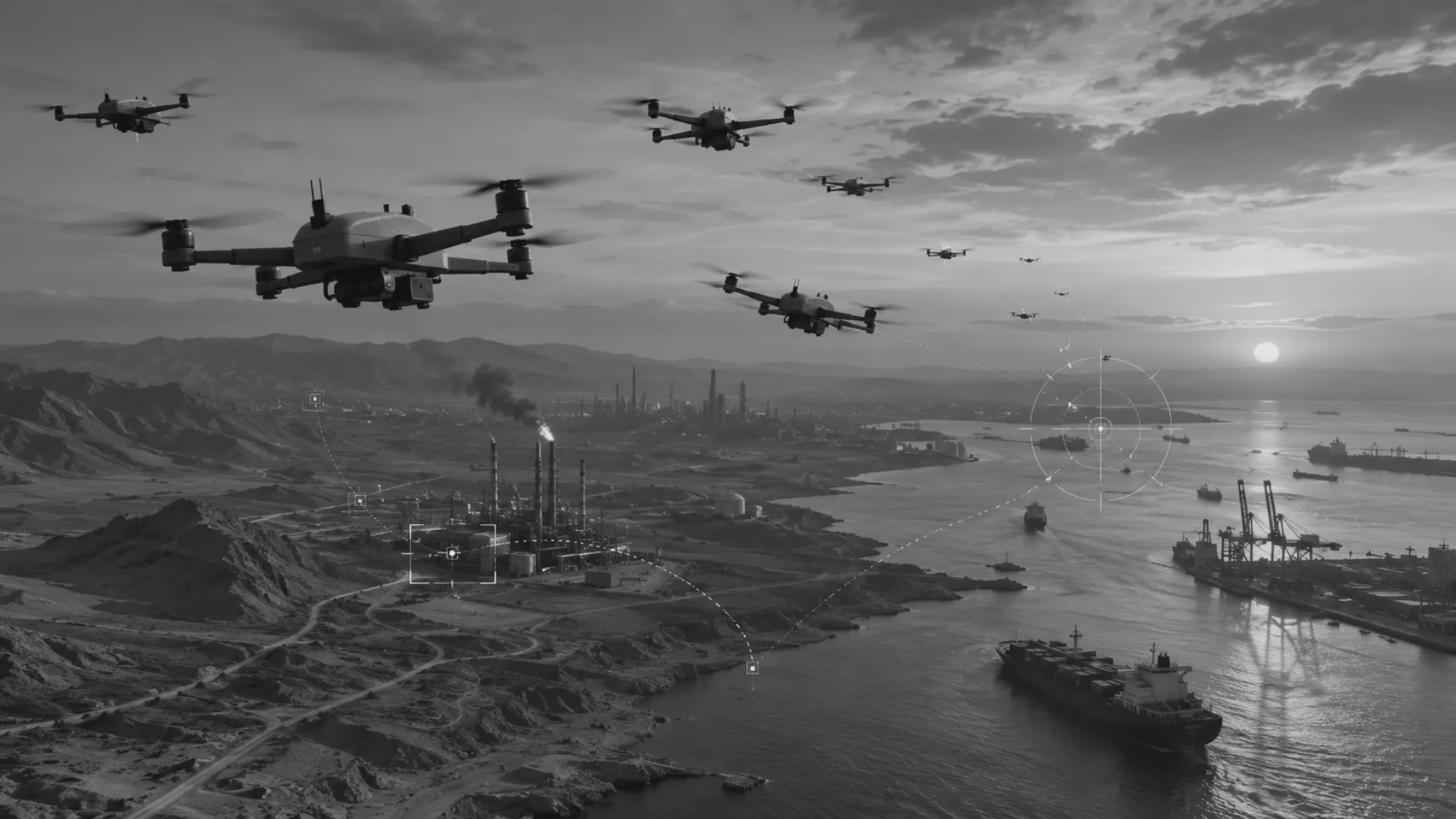
For decades, precision strike was the preserve of advanced militaries equipped with costly aircraft, sophisticated missiles and complex intelligence networks. That advantage is now eroding. Across West Asia, inexpensive drones are giving states, proxy forces and non-state actors the ability to threaten military bases, critical infrastructure, commercial shipping and national capitals at a fraction of the traditional cost. More than a technological shift, this is a redistribution of military power that is transforming deterrence, overwhelming air-defence economics and rewriting the rules of modern warfare.
Precision Warfare Is No Longer the Monopoly of Great Powers
For much of modern military history, the ability to conduct precision strikes represented one of the defining characteristics of advanced military powers. Long range air campaigns, precision guided munitions, satellite enabled targeting, and sophisticated intelligence networks required enormous financial investments and technological expertise. States that possessed these capabilities enjoyed overwhelming military advantages over their adversaries, while weaker actors remained dependent on guerrilla warfare, terrorism, or attritional strategies to offset conventional inferiority. This hierarchy is rapidly collapsing.
Across West Asia, inexpensive drones costing only a fraction of modern combat aircraft are reshaping the conduct of war. State and non state actors alike have demonstrated an unprecedented ability to strike strategic targets hundreds or even thousands of kilometres away with increasing accuracy. What was once the exclusive domain of advanced air forces is becoming accessible to middle powers, insurgent organizations, and proxy groups operating with limited financial and industrial resources.
The implications extend far beyond technological innovation. Cheap unmanned systems are fundamentally redistributing military power by lowering the barriers to precision warfare. They allow relatively weak actors to threaten critical infrastructure, military installations, commercial shipping, and even national capitals without possessing conventional air superiority. The result is a profound transformation in regional deterrence, defence planning, and crisis stability.
This article argues that the drone revolution should not be understood simply as the emergence of a new weapon system. Instead, it represents the democratization of precision strike, a structural shift that is eroding long standing military hierarchies across West Asia. By reducing the costs of strategic coercion while increasing the vulnerability of technologically superior states, drones are redefining both the economics and the politics of modern conflict.
The Economics of Precision Warfare Has Changed
Historically, conducting precision strikes required substantial military infrastructure. Modern fighter aircraft, aerial refuelling capabilities, satellite navigation, advanced targeting systems, and highly trained pilots imposed enormous financial burdens even on developed states. Precision warfare therefore remained concentrated among a relatively small number of military powers.
Unmanned aerial systems have altered this equation.
Commercial technologies, miniaturised electronics, inexpensive satellite navigation, and additive manufacturing have significantly reduced the cost of producing long range strike capabilities. A drone costing tens of thousands of dollars can threaten infrastructure protected by air defence systems worth millions. This cost asymmetry has become one of the defining characteristics of contemporary warfare.
The economic imbalance extends beyond production costs. Air defence interceptors often cost several hundred thousand dollars, while sophisticated ballistic missile interceptors may cost several million dollars per engagement. Defending against repeated drone attacks therefore imposes substantial financial burdens even when interception rates remain high.
This inversion of military economics favours persistence over technological sophistication. Instead of relying on a small number of expensive platforms, states and non state actors increasingly employ large numbers of inexpensive unmanned systems designed to exhaust defensive resources. Quantity itself has become an operational advantage.
The implications for military planning are profound. Defence establishments must now prepare for prolonged campaigns involving repeated waves of low cost drones rather than isolated attacks by conventional aircraft. Success increasingly depends not only on technological superiority but also on economic sustainability.
The Rise of Attritable Air Power
The growing importance of drones reflects a broader transformation in military doctrine. Traditional air forces treated aircraft as scarce and highly valuable assets whose loss carried significant operational and political consequences. Pilots required years of training, aircraft demanded extensive maintenance, and replacement costs remained exceptionally high.
Unmanned systems have introduced the concept of attritable air power.
Unlike conventional combat aircraft, many drones are designed with the expectation that they may not survive their missions. Their operational value lies not in individual survivability but in collective effectiveness. Military planners increasingly view drones as expendable assets capable of saturating enemy air defences, gathering intelligence, or striking strategic targets at relatively low cost.
This shift alters operational decision making in fundamental ways. Political leaders may authorise missions involving significant drone losses that would be unacceptable if they involved manned aircraft and trained pilots. Lower political risk encourages more frequent military operations while reducing domestic sensitivity to battlefield attrition.
Iran has become one of the leading practitioners of this doctrine. Constrained by sanctions and limited access to advanced combat aircraft, Tehran invested heavily in indigenous drone production. Systems such as the Shahed series have demonstrated that relatively inexpensive unmanned platforms can generate strategic effects disproportionate to their cost. Their deployment in regional conflicts has also provided valuable operational experience that continues to influence Iranian military doctrine.
Other regional actors have reached similar conclusions. Israel has long integrated unmanned systems into intelligence collection and precision strike operations. Turkey has transformed drone warfare through platforms such as the Bayraktar TB2 and Akinci, demonstrating their effectiveness in Libya, Syria, Nagorno Karabakh, and beyond. Gulf states have similarly expanded investments in indigenous unmanned capabilities.
The result is a regional arms competition centred less on acquiring expensive combat aircraft than on expanding autonomous and semi autonomous strike capabilities.
Non State Actors Have Acquired Strategic Reach
Perhaps the most significant consequence of drone proliferation is the unprecedented military empowerment of non-state actors.
Historically, insurgent organisations relied on improvised explosive devices, rockets, suicide attacks, or guerrilla tactics because they lacked the technological capacity to conduct precision strikes against distant strategic targets. Drones have dramatically expanded their operational reach.
Groups such as Hezbollah, the Houthis, Hamas, and numerous Iraqi militias have demonstrated an ability to threaten airports, military installations, naval vessels, commercial shipping, and critical energy infrastructure using relatively inexpensive unmanned systems. These operations often generate strategic and psychological effects that exceed their immediate military damage.
The Houthi campaign against commercial shipping in the Red Sea illustrates this transformation. By combining drones, anti ship missiles, and maritime surveillance, the group disrupted one of the world's most important trade routes despite possessing neither a conventional navy nor an air force. Their operations forced multinational naval deployments and compelled commercial shipping companies to reroute vessels around the Cape of Good Hope, increasing transportation costs and disrupting global supply chains.
The strategic lesson extends well beyond Yemen. Precision strike capabilities are no longer confined to sovereign states with advanced defence industries. They have become accessible to organisations operating with comparatively limited financial and technological resources, fundamentally altering the relationship between military capability and political power.
Drone Swarms and the Crisis of Air Defence
The proliferation of inexpensive drones presents a challenge that extends beyond the offensive capabilities of individual platforms. Their true disruptive potential lies in numbers. Modern air defence systems were designed to intercept relatively limited numbers of high value threats such as combat aircraft or ballistic missiles. They are far less efficient when confronted with dozens or even hundreds of low cost unmanned systems approaching simultaneously from multiple directions.
Drone swarms exploit the economic and operational asymmetry between offence and defence. A state may spend millions of dollars launching a coordinated interception effort against drones whose combined production cost represents only a small fraction of the defensive expenditure. Even highly successful interception rates can become strategically unsustainable if attacks are repeated over prolonged periods.
This challenge has become increasingly visible across West Asia. Israel's multilayered air defence architecture has demonstrated remarkable effectiveness against ballistic missiles and rockets, yet repeated drone attacks have illustrated that no defensive system can guarantee complete protection. Small drones flying at low altitudes, changing flight paths, or approaching alongside cruise missiles complicate radar detection and interception.
Saudi Arabia has faced similar challenges. The attacks against the Abqaiq and Khurais oil facilities in 2019 demonstrated how a relatively small number of drones and cruise missiles could temporarily disrupt one of the world's most important energy infrastructures. Although responsibility remains contested in political discourse, the operation exposed the vulnerability of critical national assets to inexpensive precision strike capabilities.
The future of air defence is therefore unlikely to depend solely on more sophisticated interceptor missiles. Militaries are increasingly investing in directed energy weapons, electronic warfare, artificial intelligence enabled sensor fusion, and counter drone systems capable of neutralising large numbers of unmanned platforms at lower cost. The competition between offensive drones and defensive technologies is evolving into a continuous cycle of adaptation rather than a contest that either side can decisively win.
Artificial Intelligence and the Next Phase of Unmanned Warfare
While drones have already transformed regional conflicts, artificial intelligence promises to accelerate this transformation further. Current unmanned systems often rely on pre programmed routes or human operators for navigation and target selection. Artificial intelligence is gradually reducing this dependence by enabling greater autonomy in reconnaissance, navigation, target recognition, and mission coordination.
Autonomous capabilities offer important military advantages. Drones equipped with machine learning algorithms can process battlefield information more rapidly, identify potential targets with greater precision, and coordinate operations with other unmanned platforms. Instead of functioning as isolated systems, future drones are likely to operate as interconnected networks capable of adapting to changing battlefield conditions in real time.
For West Asia, where electronic warfare and communication disruption are becoming increasingly common, greater autonomy could significantly enhance operational effectiveness. Drones that remain functional despite the loss of communication links are less vulnerable to jamming and cyber attacks, increasing their value during high intensity conflict.
Artificial intelligence also expands the strategic utility of drone swarms. Coordinated groups of autonomous systems could overwhelm defensive networks through distributed decision making, dynamically altering flight paths and target priorities without continuous human direction. Such capabilities would place additional pressure on conventional air defence architectures while reducing the effectiveness of traditional interception strategies.
At the same time, these developments raise profound ethical and strategic concerns. Greater autonomy increases the risk of unintended escalation, accidental targeting, and reduced human control over the use of force. The absence of internationally accepted norms governing autonomous weapons creates uncertainty regarding accountability, crisis management, and escalation control. As regional powers continue to invest in artificial intelligence enabled military systems, these governance challenges are likely to become increasingly significant.
Strategic Implications for West Asia
The widespread adoption of unmanned systems is reshaping military doctrine throughout the region. Rather than replacing conventional forces, drones are becoming integrated into broader concepts of deterrence, intelligence gathering, and precision strike.
For Iran, drones provide an economical means of offsetting conventional military disadvantages. Sanctions have constrained Tehran's ability to modernise its air force, making indigenous missile and drone production central to its defence strategy. These capabilities also reinforce Iran's regional partnerships by enabling technology transfers to allied organisations, thereby extending Tehran's strategic influence beyond its borders.
Israel continues to maintain qualitative superiority in intelligence, electronic warfare, and precision targeting. However, the proliferation of drones requires continuous adaptation. Defence planning increasingly focuses on integrating artificial intelligence, electronic warfare, cyber capabilities, and layered interception systems capable of responding to diverse aerial threats simultaneously.
The Gulf states face a different challenge. Their economic prosperity depends heavily on protecting critical infrastructure including energy facilities, desalination plants, ports, and commercial aviation hubs. The growing availability of inexpensive drones increases the vulnerability of these assets while complicating traditional concepts of territorial defence. As a result, regional governments are investing not only in missile defence but also in early warning systems, counter drone technologies, and integrated command structures.
The United States likewise confronts a changing operational environment. American military installations across the region have become increasingly exposed to unmanned threats from both state and non state actors. Protecting forward deployed forces now requires defence against persistent low cost aerial attacks rather than occasional conventional air raids. This shift is influencing procurement priorities, operational planning, and alliance cooperation throughout the region.
More broadly, the drone revolution is reducing the military advantages historically associated with advanced air forces. Technological superiority remains important, but it no longer guarantees uncontested control of the battlespace. Precision strike capabilities have become widely distributed, narrowing the gap between technologically advanced militaries and their less capable adversaries.
The Future Battlefield
The future battlefield in West Asia is unlikely to be dominated by large armoured formations or sustained air campaigns alone. Instead, military operations will increasingly involve combinations of drones, precision missiles, cyber operations, electronic warfare, artificial intelligence, and space based intelligence.
Future conflicts will be characterised by persistent surveillance, rapid targeting, and continuous competition below the threshold of conventional war. Infrastructure such as ports, airports, communication networks, power grids, and logistics hubs will become primary objectives because disrupting these systems can generate strategic effects without requiring territorial occupation.
Military success will depend less on the size of conventional armies than on the ability to integrate information, automation, and precision strike into coherent operational concepts. States capable of coordinating drones with cyber capabilities, satellite intelligence, and electronic warfare will possess significant strategic advantages regardless of the size of their traditional armed forces.
This evolution also places greater emphasis on resilience. Governments must prepare not only to defeat aerial threats but also to ensure that critical civilian infrastructure continues functioning during sustained drone campaigns. Defence planning therefore extends beyond military institutions to include energy security, transportation networks, emergency response systems, and industrial capacity.
Conclusion: The New Military Equaliser
The rapid spread of unmanned systems represents one of the most significant military transformations of the twenty first century. Their importance lies not simply in technological innovation but in their ability to redistribute military power across the regional security landscape.
Cheap drones have lowered the financial and technological barriers to precision warfare. They enable states with limited resources and even non state actors to threaten strategic targets that were once beyond their reach. In doing so, they challenge long established assumptions regarding conventional superiority, deterrence, and military effectiveness.
The most significant consequence is the democratization of precision strike. Capabilities that were once concentrated among advanced military powers are becoming increasingly accessible across the region. Precision warfare is no longer defined by expensive fighter aircraft and sophisticated bomber fleets. It is increasingly shaped by affordable, adaptable, and expendable unmanned systems capable of generating strategic effects disproportionate to their cost.
This transformation is unlikely to reverse. Advances in artificial intelligence, autonomous navigation, electronic warfare, and swarm technology will further expand the military utility of drones while creating new challenges for defensive systems. Future conflicts in West Asia will therefore be determined not by who possesses the largest conventional military, but by who most effectively integrates unmanned technologies into broader strategies of deterrence and warfare.
The drone revolution has not merely introduced a new weapon. It has altered the distribution of military power itself. Understanding this structural shift will be essential for policymakers seeking to navigate an increasingly contested and technologically dynamic security environment.
References
- Bendett, Samuel. The Role of Unmanned Systems in Modern Warfare. Center for Naval Analyses, 2023.
- Biddle, Stephen. Military Power: Explaining Victory and Defeat in Modern Battle. Princeton: Princeton University Press, 2004.
- Brose, Christian. The Kill Chain: Defending America in the Future of High Tech Warfare. New York: Hachette, 2020.
- Center for Strategic and International Studies. Countering Unmanned Aircraft Systems. Washington, DC, 2024.
- Clausewitz, Carl von. On War. Edited by Michael Howard and Peter Paret. Princeton: Princeton University Press, 1976.
- Freedman, Lawrence. The Future of War: A History. London: Allen Lane, 2017.
- Hambling, David. Swarm Troopers: How Small Drones Will Conquer the World. London: Constable, 2015.
- Horowitz, Michael C. The Diffusion of Military Power: Causes and Consequences for International Politics. Princeton: Princeton University Press, 2010.
- International Institute for Strategic Studies. The Military Balance 2025. London: Routledge, 2025.
- Kallenborn, Zachary. Drones and Terrorism: Asymmetric Warfare in the Twenty First Century. Routledge, 2024.
- RAND Corporation. The Drone Revolution: Implications for Military Competition. Santa Monica, 2024.
- Royal United Services Institute. Drone Warfare in the Middle East: Strategic Lessons and Future Trends. London, 2024.
- Scharre, Paul. Army of None: Autonomous Weapons and the Future of War. New York: W. W. Norton, 2018.
- Scharre, Paul. Four Battlegrounds: Power in the Age of Artificial Intelligence. New York: W. W. Norton, 2023.
- SIPRI. SIPRI Yearbook 2025: Armaments, Disarmament and International Security. Oxford: Oxford University Press, 2025.
- United Nations Institute for Disarmament Research. The Weaponization of Increasingly Autonomous Technologies. Geneva, 2023.
- Watts, Barry D. The Maturing Revolution in Military Affairs. Center for Strategic and Budgetary Assessments, 2011.
- Work, Robert O., and Greg Grant. Beating the Americans at Their Own Game: An Offset Strategy with Chinese Characteristics. Center for a New American Security, 2019.
- International Crisis Group. Containing Conflict in the Middle East's Drone Age. Brussels, 2024.
- Reuters. "Drone Warfare Reshapes Military Calculations Across the Middle East." 2024.
The views expressed are those of the authors and do not represent the views of CNAWS.
Image Source: ChatGPT
Tags
- #Cheap Drones
- #Counter-Drone Technology
- #Drone Swarms
- #drone warfare
- #Future of Warfare
- #military drones
- #Precision Strike
- #West Asia security
Author
Taha Ali
Taha Ali is a Research Assistant at the Centre for Migrant Studies, University of British Columbia, and a Research Fellow at the Takshashila Institution. He holds an M.A. in Conflict Analysis and Peacebuilding from Jamia Millia Islamia. His research focuses on South Asian security, nuclear policy, political violence, Islamist movements, and the geopolitics of West Asia. His work has appeared in leading policy and academic platforms, including the Middle East Forum, South Asian Voices, South China Morning Post, United Service Institution of India, Modern Diplomacy, and the Journal of Peace Studies.