Department of Disruptive & Emerging Technologies · Articles · Defence Technology ·
China’s AI-Enabled Swarm Warfare and Implications for India’s Northern Theatre
With an emerging sphere of drone tactics and swarm warfare, the contested frontiers along the high-altitudinal ridges get a massive redefined character of conflict. As China continues to operationalize autonomous drone swarms under its Military-Civil Fusion Strategy, a critical bottleneck, spanning across Ladakh, Sikkim and Arunachal Pradesh, resurfaces for the Indian Northern Theatre Command. This article critically examines the maturity of China’s swarm capabilities, its operational implications, strategic gaps and adaptive options for the Indian state, the essence of a space-based architecture, air power calculus, budgetary and skilling disparities, facet and risks of private sector integration, joint-force multi-scale deterrence, and the diplomatic levers nestled in the core Indian cockpit. It hence argues and calls for India’s multi-domain, urgently funded and progressively innovative response
The State of Maturity of the Chinese Drone Defence
An autonomous investment in the drone swarm technology by the People’s Liberation Army (PLA) undoubtedly represents one of the most consequential shifts in the military capacity, ever since the introduction of the precision-guided munitions. China has often displayed clear and concrete intent whilst displaying the coordinated manoeuvres of more than a thousand fixed-wing drones, like in 2017.[i] Conclusively, the speed matters, what calls India made beyond COVID and the automation necessity period, were made half a decade before in China. This proactive timeline embellished the Western Theatre Command of the PLA to nudge the Sino-Indian frontier with an immersive integration of the swarm drones into the combined-arms exercises. These are not mere signals; these are proofs of futuristic destruction bidding in the enemy minds.
The spine of the drone capacity of China is figured in its formidable industrial base. The supply chain remains isolated to the native land, and largely undisrupted. Giants like DJI, AVIC and CASC operate within a carefully crafted Military-Civil Fusion framework and transforms into a pragmatic production chain. One that compresses the cycle from development to deployment with, rather less but efficient intermediaries. The enemy wisely and more so, unscrupulously, plants shell or veiled companies into the Indian Government E-Marketplace (GeM) Network, making the civil fusion in India, a critical bottleneck and a barren land bearing the fruits of security leakage. This delay puts India into a backfoot with no absolute native-systemic-failure. Additionally, as China treads into the segment of producing heterogenous swarms, combinations of fixed-wing, rotary, and loitering munitions, capable of communication via mesh networks, adaption to jamming, and re-task capabilities, it climbs another pedestal. The unique Himalayan-Tibetan Plateau juncture gives China an advantage if it wins the AI algorithm training for this unconventional terrain. It has distributed command architectures that function without GPS, real-time target discrimination capabilities of individual drone, electronic warfare hardened communication and even swarm-to-swarm engagement protocols. China is not experimenting, its operationalizing.[ii]
Why Swarm Warfare Matters
Drone Swarms quietly nestles where the conventional air and ground forces struggle. This is precisely why in the emerging multipolar world and at the face of dynamic threats, swarm warfare matters. In a critical situation a swarm of 200-500 drones tend to overwhelm point defence systems due to functional overload and repetitive attack. What remains catastrophically unfavourable is the high cost-exchange ratio of engagement between India’s Akash missile batteries or Man-Portable Air-Defence System (MANPADS) with the swarms. This is saturation.
Redundancy is another challenge. Intrinsically, swarms are tolerant to faults. Swarm network reroutes tasks before a human mind detects ineffectiveness. Multi-axis penetration is a bubbling facet of the swarms. The ability to probe mountains, logistics arteries, and forward operational bases simultaneously keeps the edge with the attacker. Fourth, the Intelligence-Surveillance-Reconnaissance (ISR) saturation makes conquest in the Depsang Plains or Tawang Valleys a domitable casket by the enemy’s side. At the high-altitudes, nothing seems to remain conventional. A drone swarm can engage into multidimensional attack on the Darbuk-Shyok-DBO Road, the Indian lifeline to the Daulat Beg Oldie post. Hence, what subdues is the shoulder of human commanders for managing an emergent multi-vector swarm attack, another weapon, often undocumented.
The India Way
Investing into architecture, not mere technology is the dire need. While procuring counter-drone systems is a necessity, it is not a sufficiency. Positive policy decisions like the Indian Army’s Drone Federations concept, needs acceleration and doctrinal adaptation, not mere ideation. Infusing finances into building a coherent, complete and conceptual asymmetric counter-swarm capabilities is another component requiring active deliberation. Directed energy weapons, lasers and high-power microwave systems, cognitive jamming enabled electronic warfare suites and an indigenous, yet globally stipulated, own offensive swarm capability to potentially rupture PLA budget lines must be tabled. Promising initiatives, like Bhargavastra programme of the Defence Research and Development Organisation (DRDO), combined with the indigenously developed Counter Unmanned Aircraft Systems (UAS) from Bharat Electronics Limited (BEL) require a battlefield readiness trajectory. [iii]
The bells of transitioning from a platform-centric warfare to a network-centric conquest regime, with sensor-fused operations where real-time data from satellites, Airborne Warning and Control System (AWACS), and ground sensors converge, must start ringing. This argument is expository for building an AI-enabled battle management system into the Northen Theatre Command, capable of processing and prioritizing swarm threats faster than human reaction time.
The Constraints of Budget, Skilling, and Adaptability
On comparison between the budgets of both India and China, what becomes evident is not only a quantitative gap, but also a structural digression. About fifteen to twenty percent of China’s defence budget is directed towards emerging technology domains including AI, electronic warfare and autonomous systems. It also becomes crucial to underline the degree of press freedom in China to trust the public figures, the reality could be a massive whirlpool. On the contrary sets an Indian budget, amputated by about one-thirds and rigourously overloaded by revenue obligations, salaries and pensions, consuming about fifty-five percent[iv] of the funds allocated. China smartly cross-subsidizes its military capabilities by allowing dual usage of the R&D expenditure under the umbrella Military-Civil Fusion strategy. This is hidden from the official budget receipts. Additionally, if the private investments undertaken by big players are factored in, the net technology development spend appears to be grossly understated. India remains silent on such aspects.
Skilling and adaptability are fuels to autonomous warfare. PLA has operationalized dedicated drone warfare Military Occupational Specialties with comprehensive training pipelines[v] feeding both operational and managerial personnels. India needs to comprehensively redevelop its military training appendices, encouraging modern-battlefield-readiness, early on from the training days. Treating drone operational skills as supplementary instead of a primary combat specialty is pushing India into hollow dungeons. Coercive and strategic integration of the Indian Air Force, Indian Army, Indian Navy and the Indian Coast Guard, instead of a semi-independent, quasi-autonomous framework perhaps, would bridge the gap with a unified structure and multi-purpose dynamic skillset cohesion.
China’s authoritarian chains largely benefit the adaptability and efficiency of its forces. Decisions on procurements, deployments and actions tend to get executed without friction and delays. India’s democratic deficit in decision speed is real, and has not gone undocumented, however accountability remains an issue. Parliamentary scrutiny, inter-service rivalry, coalition politics bring India at a sensitive nexus of democracy and defence. Result: India crawls while the threat moves at an algorithmic speed.
Embedding Space Architecture as the Backbone of Drone Warfare
It is not possible to isolate drone warfare from space power. A robust space architecture propels drone infrastructure and decides who wins[vi]. Position, navigation and timing (PNT) real-time data is the foundation of a successful swarm attack. China’s commercial operators have mastered the revisit cycles over the Himalayas, embedding a space-to-drone autonomous mission pipeline for updates mid-flight. India is yet to replicate or calibrate[vii] anything of this scale. While India’s space sector brings laurels at the international stage, and grows commendably, it falls behind in mastering the ISR revisit cycles. A redirection into this segment undoubtedly carries the possibility of reaping a high return on investment.
Bilateral Assessment of the Critical Bottlenecks in Drone Warfare
China, also plummets and pivots by facing constraints, despite its exponential progress in the swarm tactics. Given the thin air above 5,000 meters the rotor lifts and battery efficiency drops, giving the high-altitude drone performance statistics a shock. Battery chemistry remains largely impacted due to the extremity in diurnal temperatures of the Tibetan Plateau. Dust storms tend to impair the optical sensors. Consequentially, the AI Models trained on the Middle Eastern terrain tends to perform below optimum levels in the distinctive electromagnetic and meteorological conditions of the Himalayas.
India’s bottlenecks persist, but much differently. While the Chinese supply chain is largely in-house, India’s domestic drone industry relies heavily on Chinese components. This is a sensitive supply-chain vulnerability that could prove to be catastrophic with a battle knocking the Indian doors. For decisions and punitive action, India lacks a unified structured doctrine involving all stakeholders. Operationalizing the tactics in silos renders weakness in the asymmetric game. Theatre commands are designed but the diagonal and lateral communication channels remain segmented, making joint swarm operations, another operation in itself. Engagement of border forces with the war-time forces is compact and brief, instead of complementary and detailed. Regulatory constraints imposed by the Directorate General of Civil Aviation (DGCA) births civil-military friction. India also lacks a coextensive AI-enabled anti-swarm framework, essentially eliminating the requirement of human authorization at each stage of engagement.
The Pragmatic Imperative
China’s AI-enabled swarm warfare capability represents a gradual yet generational shift in the character of conflict along the Northern and North-Eastern Frontiers of India. The threat is no longer hypothetical, it is rather on a brink, near-term, operationally credible and structurally advantaged by China’s robust backing[viii]. India is not incapable, it is merely behind the curve.
The pragmatic course is neither complacency nor panic. It necessitates an urgent budget reallocation and disposal into the correct trajectory of autonomous systems, directed energy, AI-driven battle management, empowerment of private sector, systemic civil-military fusion, while preserving technological sovereignty. Another strategic weapon would be to institutionalize a unified joint doctrine for the Northern Theatre that equips itself as a drone swarm deterrent and treats it both as a threat and a primary offense instrument. An aggressive use of international partnerships to exponentially develop technical capabilities without sacrificing operational independence, and inhibiting global best practices.
Above all, India must recognise that the future of warfare in the Himalayas will be decided not by the soldier with the best rifle but by the nation with the fastest, most resilient, and most autonomous decision-making architecture. That is the strategic terrain India must urgently contest.
References
- People’s Liberation Army Daily. “Drone Swarm Exercise Simulates Strike on High-Value Maritime Target.” Xinhua Defence Review (Beijing), 2021.
- Kania, Elsa B. “Chinese Military Innovation in the AI Revolution.” RUSI Journal 165, no. 5–6 (2020): 26–34.
- Ministry of Defence, Government of India. Annual Report 2022–23. New Delhi: MoD Publications, 2023.
- Singh, A. “Drone Warfare and the Himalayan Frontier: India’s Strategic Blind Spots.” Journal of Defence Studies 18, no. 2 (2024).
- Stockholm International Peace Research Institute. SIPRI Military Expenditure Database 2025. Stockholm: SIPRI, 2025.
- Panda, Ankit. “India-US iCET and the Implications for Defence Technology Cooperation.” Carnegie Endowment for International Peace, 2023.
- China Aerospace Science and Technology Corporation (CASC). Annual Innovation Report. Beijing: CASC Publications, 2022.
- DRDO Technology Focus. “Bhargavastra Counter-Drone System: Development and Testing Update.” Issue 47 (2024).
- Clover, Charles. “BeiDou: China’s Answer to GPS Now Has More Satellites Than Its Rival.” Financial Times, March 2022.
- Roul, Animesh. “India’s Northern Theatre Command and Integrated Warfighting Doctrine.” Strategic Analysis 48, no. 3 (2024).
- iDEX India (Defence Innovation Organisation). Annual Report 2024–25. New Delhi: Ministry of Defence, 2025.
- Mehta, Aaron, and Franz-Stefan Gady. “The Coming Drone War Over the Himalayas.” Foreign Affairs, November 2023.
- Space Policy Institute. “NavIC Integration in Indian Military Platforms: Progress and Gaps.” George Washington University, 2025.
- Bitzinger, Richard A. “Military-Civil Fusion and Chinese Defence Innovation.” RSIS Working Paper No. 362. Singapore: S. Rajaratnam School of International Studies, 2024.
- Observer Research Foundation. “India’s Private Defence Sector: From Policy to Battlefield Relevance.” ORF Occasional Papers. New Delhi: Observer Research Foundation, 2025.
[i] People’s Liberation Army Daily. “Drone Swarm Exercise Simulates Strike on High-Value Maritime Target.” Xinhua Defence Review (Beijing), 2021.
[ii] Kania, Elsa B. “Chinese Military Innovation in the AI Revolution.” RUSI Journal 165, no. 5–6 (2020): 26–34.
[iii] DRDO Technology Focus. “Bhargavastra Counter-Drone System: Development and Testing Update.” Issue 47 (2024).
[iv] Stockholm International Peace Research Institute. SIPRI Military Expenditure Database 2025. Stockholm: SIPRI, 2025
[v] Kania, Elsa B. “Chinese Military Innovation in the AI Revolution.” RUSI Journal 165, no. 5–6 (2020): 26–34.
[vi] Space Policy Institute. “NavIC Integration in Indian Military Platforms: Progress and Gaps.” George Washington University, 2025
[vii] Clover, Charles. “BeiDou: China’s Answer to GPS Now Has More Satellites Than Its Rival.” Financial Times, March 2022
[viii] China Aerospace Science and Technology Corporation (CASC). Annual Innovation Report. Beijing: CASC Publications, 2022
The views expressed are those of the authors and do not represent the views of CNAWS.
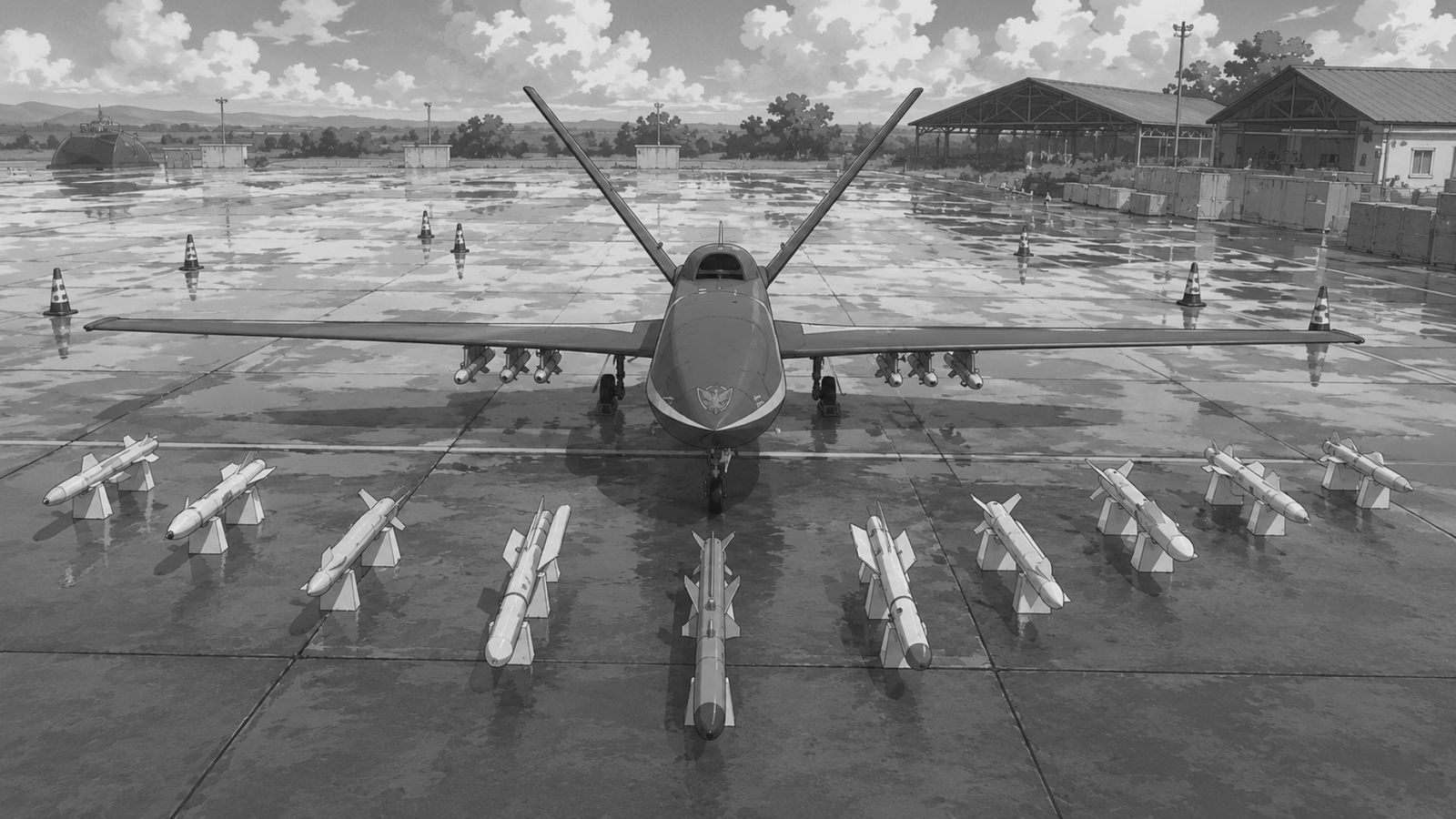
Image Source: ChatGPT
Tags
- #AI warfare
- #autonomous drones
- #China drone swarms
- #drone warfare in Himalayas
- #future warfare
- #India China border
- #military artificial intelligence
- #swarm warfare
Author
Priyal Jain
Priyal Jain is a former Indian Air Force Flying Cadet having rigorously trained for 2 years at the National Defence Academy. In addition to her core experience in the security, defence, and strategy domain, she is also an avid learner of Economics, Geopolitics and International Relations. She currently progresses in the field of public policy, consultation and strategy design.